
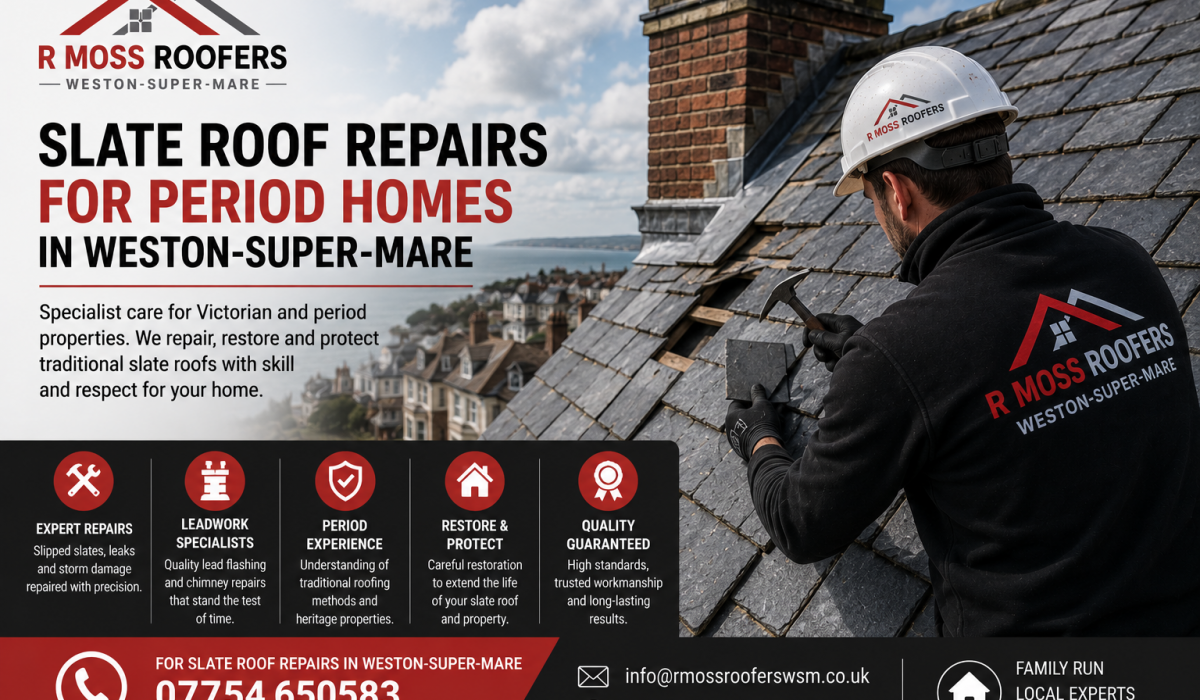
Weston-super-Mare contains many Victorian, Edwardian and traditional properties whose roofs contribute significantly to their character.
Natural slate can provide exceptional service when correctly installed, but older slate roofs often develop problems with fixings, battens, flashing, valleys and previous repair work.
Effective slate roof repair requires more than replacing whatever has fallen to the ground. The surrounding roof must be assessed to identify why the slate moved and whether the defect is isolated or part of a wider pattern.
Why Do Slates Slip?
A slipped slate may be caused by:
- Corroded or failed nails
- Broken slate
- Deteriorated timber battens
- Wind uplift
- Incorrect previous repairs
- Movement around chimneys or valleys
- Impact damage
- Inadequate fixing
- Foot traffic
- Widespread nail fatigue on an older roof
When many slates begin slipping, repeatedly replacing individual pieces may not address the underlying condition.
The Importance of Matching Replacement Slates
Replacement slate should be selected with consideration for:
- Size
- Thickness
- Colour
- Texture
- Geological type
- Weathering
- Existing headlap
- Roof pitch
An obviously mismatched repair can affect the appearance of a period property. Incompatible sizes or thicknesses can also make it difficult to maintain correct alignment and weather protection.
Reclaimed slate can sometimes provide an appropriate match, but every replacement should be checked for condition and suitability.
Traditional Fixings and Modern Repair Methods
Older slate roofs were commonly fixed using nails. Over time, these fixings may corrode or pull through enlarged holes.
Repair methods depend on the position of the slate and surrounding roof condition. They may include replacing the slate with suitable fixings, using approved repair clips or opening a larger area where battens have failed.
Visible sealants and improvised surface fixes rarely provide the appearance or durability expected on a traditional slate roof.
Leadwork Around Period Roofs
Slate roofs often contain detailed leadwork around:
- Chimneys
- Dormers
- Valleys
- Parapets
- Abutments
- Roof junctions
- Bay windows
Lead must be installed in suitable sections that allow for movement. Long, poorly detailed pieces can split or lift as temperatures change.
Older repairs may also contain cement fillets where properly detailed flashing would provide better long-term protection.
Chimney Stacks and Slate Roof Leaks
Many period-property leaks occur around chimney stacks rather than through the main slate covering.
Potential defects include:
- Failed lead flashing
- Damaged soakers
- Cracked flaunching
- Open mortar joints
- Porous brickwork
- Damaged chimney pots
- Defective back gutters
- Water entering around unused chimney openings
A complete inspection should include both the stack and the surrounding slate details.
Roof Ventilation in Older Homes
Traditional buildings often behaved differently before modern insulation, double glazing and draught-proofing were introduced.
Energy-efficiency improvements can reduce uncontrolled airflow, increasing the importance of a considered ventilation strategy.
Signs of moisture problems include:
- Damp roof timbers
- Mould
- Wet nail points
- Damp insulation
- Musty odours
- Condensation beneath underlay
Ventilation alterations should be designed for the particular roof rather than added randomly.
Conservation Areas and Listed Buildings
Like-for-like roof maintenance does not always require planning permission, but additional controls may apply to listed buildings, flats and properties in designated areas.
Planning Portal guidance recommends checking with the local planning authority where a building is listed or situated in an area with additional restrictions.
Materials and visible detailing may need to preserve the property’s architectural character.
When Is Slate Roof Restoration Appropriate?
Restoration may be considered where many original slates remain reusable but the fixings, battens, underlay or leadwork have deteriorated.
A restoration project may involve:
- Carefully removing existing slates.
- Assessing and setting aside reusable material.
- Repairing structural defects.
- Installing suitable underlay and battens.
- Re-laying serviceable slate.
- Introducing matching replacement slate where required.
- Renewing leadwork and roof junctions.
- Reviewing ventilation.
The specification should be based on the roof’s actual condition.
Arrange a Slate Roof Inspection
R Moss Roofing Services provides slate repairs, roof restoration, chimney repairs and leadwork across Weston-super-Mare and surrounding areas.
Call: 07754 650583
Email: info@rmossrooferswsm.co.uk
Frequently Asked Questions
Can one slipped slate be repaired?
Yes, when the defect is isolated and the surrounding battens, fixings and slates remain sound.
Why do several slates keep slipping?
Repeated movement can indicate deteriorated fixings, damaged battens, wind exposure or wider age-related failure.
Can reclaimed slate be used?
Suitable reclaimed slate may provide a close visual match, but it should be inspected for strength, thickness and condition.
Does a slate roof need replacing when it leaks?
Not necessarily. The leak may originate from one slate, a valley, chimney flashing or another roof junction.